
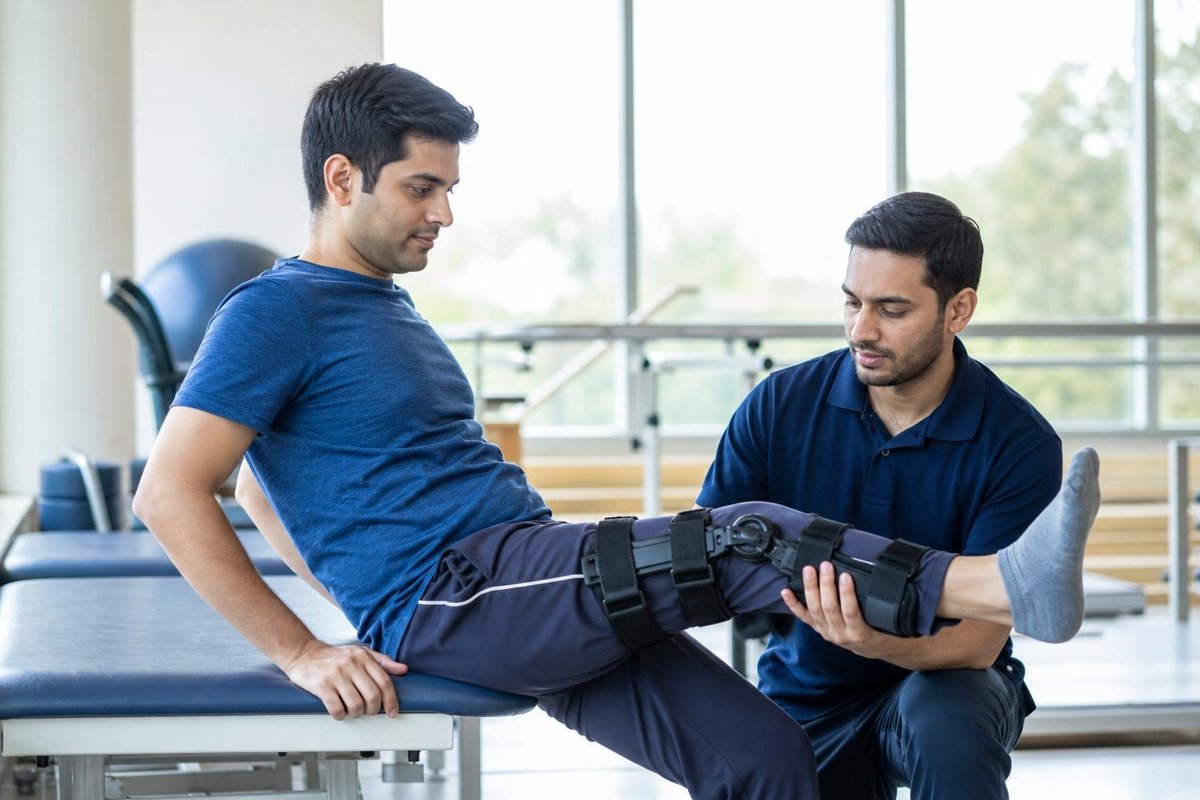
A PCL (posterior cruciate ligament) injury often happens when the shin is hit from the front, as in a dashboard injury or a fall on a bent knee. Many isolated PCL tears are treated without surgery using a brace and focused physiotherapy, while tears combined with other ligament damage or a bony fragment may need reconstruction or fixation. An orthopaedic examination, X-ray and MRI help decide the right path.
The car stopped hard near the Tribune Chowk light. His knee hit the dashboard. At first it only felt bruised.
Three weeks later, the 32 year old bank employee from Kharar came to us saying something odd: “Walking on flat road is fine, but going down the stairs at my office, the knee feels loose, like it is sliding backwards.” He had already been told by a friend that ligament injuries always need an operation.
That is not quite true. And PCL injuries are a good example of why.
What is the PCL and how does it get injured?
The posterior cruciate ligament sits deep inside the knee, behind its better known partner, the ACL. Its job is to stop the shin bone from sliding backwards under the thigh bone. It is thick and strong, so it usually takes a real force to tear it.
The two classic ways are a direct blow to the front of the shin with the knee bent, which is the dashboard injury we see after road accidents on the highways around Tricity, and a fall straight onto a bent knee. Footballers and kabaddi players get it too, as do people who slip on wet tiles during the monsoon.
What does a PCL injury feel like?
PCL tears are often quieter than ACL tears. Many people do not hear a pop. They notice:
- pain and swelling at the back of the knee
- a feeling of looseness, especially going downstairs or downhill
- discomfort when kneeling, which can make prayers at the gurdwara or sitting on the floor difficult
Because the early pain fades, some patients ignore it for months. We think that is a mistake. A PCL that has not been assessed may hide other damage, and the knee can slowly develop wear behind the kneecap and on the inner side.
How do we diagnose it?
It starts with the examination. With the knee bent, the surgeon checks whether the shin sags backwards compared to the other side. That simple test tells a lot.
An X-ray comes next, partly to see whether the ligament has pulled off a small piece of bone where it attaches. An MRI then shows the grade of the tear and whether the ACL, the collateral ligaments, the meniscus or the corner structures at the back of the knee are also hurt.
Do all PCL tears need surgery?
No. This is where the PCL differs from the ACL in many cases.
An isolated partial PCL tear frequently does well with a brace that supports the shin from behind, followed by a planned rehab programme. The quadriceps muscle at the front of the thigh helps hold the shin forward, so strengthening it is the centre of treatment. Our physiotherapy and rehabilitation team works through this step by step, from gentle range of motion to stairs and, later, sport.
Surgery is more likely to be discussed when:
- the PCL has pulled off a fragment of bone that can be fixed back
- several ligaments are torn together, often after a high energy accident
- the knee remains unstable and painful in spite of a proper rehab trial
Reconstruction is usually done arthroscopically, using a graft to replace the torn ligament. Our approach to ligament work is outlined on the arthroscopy and sports medicine page. If the injury came with broken bones around the knee, it falls into the care described under complex trauma and fracture treatment.
Why is choosing a PCL injury specialist in Chandigarh important?
PCL injuries are less common than ACL tears, and the injuries that travel with them can be missed. A careful knee surgeon looks at the whole joint, not just one ligament on the scan.
Timing also matters. Bony avulsions and multi ligament injuries are often handled sooner, while isolated tears are usually given time with rehab first. Getting that call right in the first few weeks can save a lot of trouble later.
Our honest advice to that bank employee from Kharar was simple. Brace, physio, regular review. He was back to his evening walks in Sector 70 park before Lohri.
Frequently Asked Questions
Can I walk with a torn PCL?
Many people can walk on flat ground fairly soon after an isolated PCL injury, but stairs, slopes and running often feel unstable. Walking does not mean the knee has healed, so get it assessed.
How long does PCL recovery take without surgery?
It depends on the grade of the tear and your goals. Daily activities often return within weeks, while sport takes longer. Your surgeon and physiotherapist will set a timeline after examining you.
Is a PCL injury worse than an ACL injury?
Not necessarily. Isolated PCL tears are often managed without surgery. Combined ligament injuries, however, can be serious and need specialist care.
Will I need a knee brace?
Many patients use a specific PCL brace for a period in the early phase. Your doctor will tell you whether you need one and for how long.
If your knee has felt loose since a fall or accident, please book an appointment at COJRI so we can examine it and talk through your options.
NAP: COJRI Contact Information
Name: Chandigarh Orthopaedics & Joint Replacement Institute (COJRI)
Primary Centre: Max Hospital, Phase 6, SAS Nagar, Mohali, Punjab
Chandigarh Clinic: Singla Clinics, House No. 3, Sector 19A, Chandigarh, 160019
Panchkula Clinic: House No. 222, Sector 4, Panchkula, Haryana 134112
Dr. Sandeep Gupta: +91 98159 33514
Dr. Jatinder Singla: +91 84272 70319
Email: info@cojri.com
Connect With COJRI
Connect with COJRI for more education on hip and knee replacements, robotic joint surgeries and other specialties in orthopaedic care.
- LinkedIn: Dr. Sandeep Gupta on LinkedIn
- Email: info@cojri.com
- Appointments: +91 98159 33514 / +91 84272 70319
- GMB: https://share.google/26IbbT8qszb0M1tUa
If you are searching for the hip pain specialist panchkula, then click here