
Knee Replacement Without Pain Chandigarh: How AI-Based Knee Replacement Can Support Better Recovery
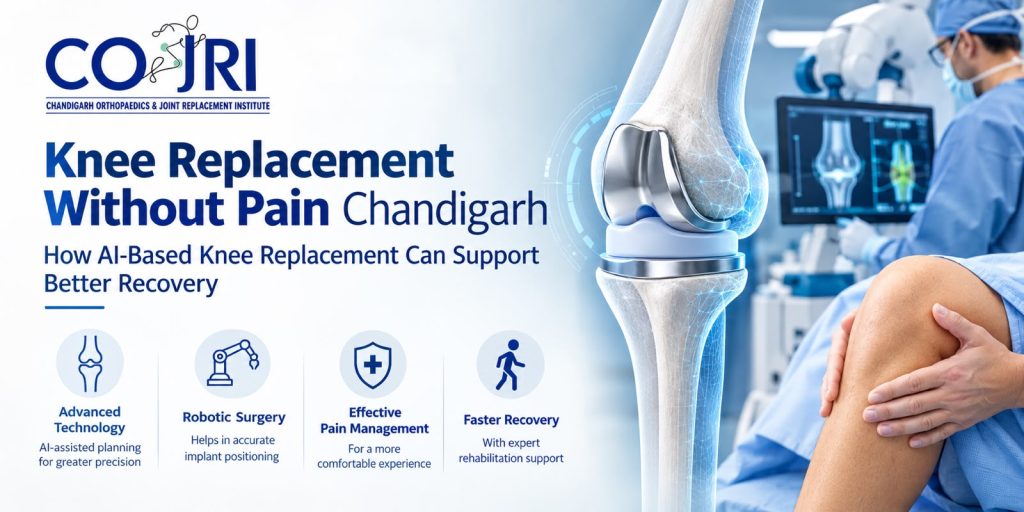
Knee joint pain greatly affects an individual’s quality of life. Joint pain restricts day to day activities and advanced cases of osteoarthritis may even restrict morning walks. Knee replacement surgery is an effective option for patients when conservative treatment such as pain medications and rehabilitation become inadequate. Patients looking for knee replacement without pain Chandigarh should know that pain management and advanced surgical techniques have improved the precision of surgical procedures and supported the recovery process. Artificial Intelligence (AI) can help surgeons develop patient-specific surgical plans. The Chandigarh Orthopaedics & Joint Replacement Institute (COJRI) uses advanced techniques of robotic surgery for knee replacement and has rehabilitation specialists onsite to assist the recovery process. What Does Knee Replacement without Pain Mean? A surgical patient always wants a pain-free surgery and improvement in the quality of life (QoL) after surgery. A joint replacement surgical patient always looks to be free of pain while doing activities of daily living (ADL). While the improvement in QoL after surgery cannot be guaranteed, the surgeon works towards this goal. Pain management during surgery includes use of anaesthetic agents while pain management post surgery includes pain medications and rehabilitation. Responsible surgeons cannot guarantee total elimination of pain. Chronic knee pain reduces mobility and makes everyday tasks difficult. The goal of a knee replacement surgery is to ease chronic joint pain, increase mobility, and provide independence to perform daily tasks. Symptoms of chronic knee pain that may indicate the need for an orthopedic evaluation include: The above symptoms may not warrant knee replacement surgery. A doctor will perform an evaluation and determine if other treatment options (i.e. rehabilitation, different surgeries, or joint replacement) are available. What is AI-Based Knee Replacement? AI-based knee replacement chandigarh is the use of integrated technology during knee replacement surgery. Integrated technology can include digital and 3D planning, computer-assisted measurement, and surgical guidance with robotics. At COJRI, we use integrated technology in combination with the Mako robotic system for surgical planning and prosthesis positioning. The process is described in the following steps. 1.Individualized Surgical Planning An orthopedic surgeon evaluates the patient’s knee using clinical examination and appropriate imaging. Using a digital plan, the surgeon determines the location of the joint and the position of the intended implant. DURING SURGERY: The system supports the surgeon by guiding the preparation of the bone and the positioning of the implant. THE SURGEON STAYS IN CONTROL: The system does not run the surgery. The orthopaedic surgeon makes the clinical decisions and performs the surgery. The system is an additional tool in the procedure. THE GOAL IS JOINT FUNCTION: The focus of total knee replacement is functional. The goal of the procedure is to restore the patient’s ability to perform daily activities by replacing the damaged knee joint with an artificial joint and balancing the soft tissues. The implant is positioned to create a joint that allows a range of motion and function during recovery. AI-based and robotic-assisted surgery have many benefits, and the same is true for knee replacement surgery. PRECISE SURGICAL PLANNING: The robotic system provides the surgeon 3D views of the knee, aids in planning and situating the implant before surgery, and supports in making adjustments to align the implant. ALIGNMENT: In knee replacement, achieving the correct alignment of the implant is very critical. The positioning of the implant is important in achieving the desired function of the joint and the durability of the implant. BOUNDARY SUPPORT: During bone preparation, the surgeon uses the robotic system to work in the planned boundaries. This may help in protecting unintended structures and tissues, based on the patient’s anatomy and surgical approach. An Approach to Pain Management Surgical procedures and anaesthesia are just a few parts of the overall management of pain. Swelling, prescribed medications, movement, and physiotherapy also affect pain control. Help with Early Rehabilitation Many patients begin early controlled movement after their knee replacement, and a personalised program can help improve strength, flexibility, and balance. Relying on a robot does not always mean less pain or quicker recovery for all patients. Discuss this with your surgeon. Before Surgery The Orthopedic Surgeon will assess the knee and review the patient’s history. Further tests may be ordered to assess blood pressure and blood sugar to name a couple. The surgical team will discuss the procedure and anesthesia, duration of stay, risks and expected rehabilitation. During Surgery In a typical total knee replacement, the damaged knee joint is removed and replaced with an artificial joint. This procedure is performed using anesthesia to ensure no pain is experienced during the surgery. If a robotic system is being used, it will assist the surgeon in performing the surgery based on a pre-operative surgical plan. After Surgery During the post operative period, the team will monitor the patient, manage pain and swelling. The patient may begin to walk with support and perform physical exercises to aid in recovery and regain movement. Physiotherapy plays an important role in restoring the normal range of motion of the knee and aids in overall recovery. During Recovery The period of recovery is different for each individual and may take longer for some to regain complete function of the replaced knee. Typically, individuals may be able to perform general activities of daily living in a matter of weeks, but continue to improve and gain more strength and function in the replaced knee for several months. In order to assist in the overall recovery of the replaced knee, it is best to adhere to the recommendations of the medical team, attend physiotherapy, and take prescribed medications. It is also important to avoid any activities that may increase stress and load on the replaced joint. Frequently Asked Questions 1. What is a pain free knee replacement? During the surgery, anaesthesia is given to make the patient insensible to pain; however, swelling and some degree of pain is inevitable during the recovery process and complete absence of pain during this process is not possible. 2. What is AI knee replacement?