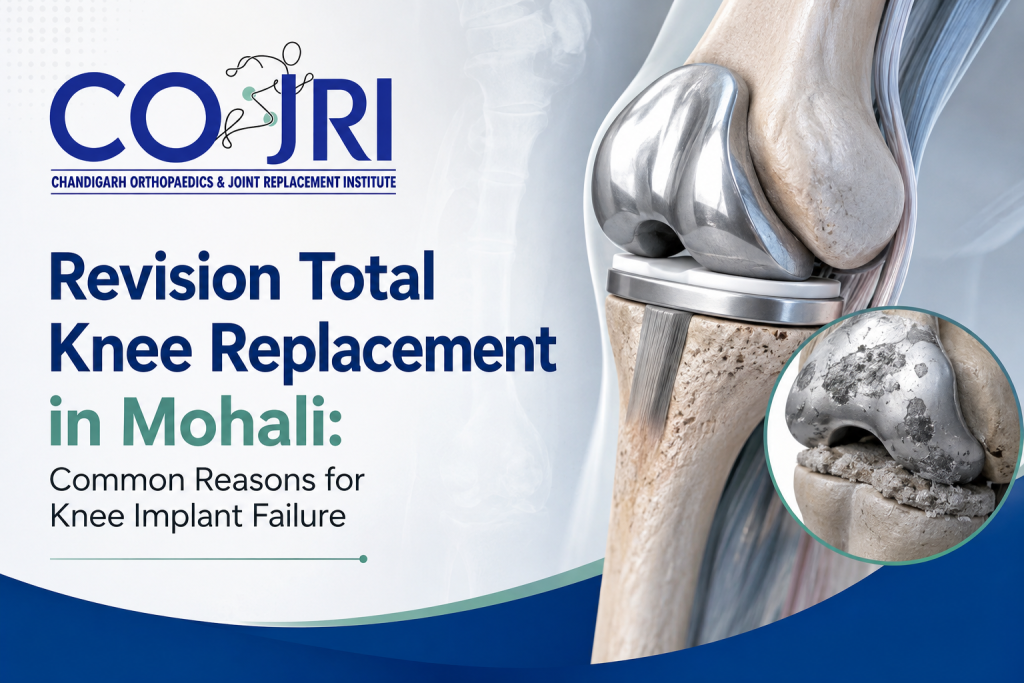
Revision Total Knee Replacement in Mohali: Common Reasons for Knee Implant Failure
Total knee replacement can be considered by many as a revolutionary treatment as it relieves those who have suffered from chronic knee pain due to arthritis or damaging of the joints. While it is one of the many effective solutions at restoring mobility and significantly improving the quality of life, knee implants are not completely immune to the problems of the body and the passage of time. There are many cases where the patient has to undergo another surgery to either replace or repair the knee implant. This procedure has been termed as Revision total knee Replacement Mohali and involves restoring the lost function and stability of the knee when the previously replaced knee has failed to serve its purpose. For existing patients and especially for the future patients, it is extremely important to understand the reasons behind the failure of the knee implant. Patients presenting the early signs of knee implant failure and possibly the need to undergo revision surgery are more likely to result in a surgical solution of greater success. What Is Revision Knee Replacement? Revision knee replacement is the term given for the procedure that takes place when a patient has knee surgery and a portion or all of the previously implanted knee joint is replaced with another implant. Because the original knee joint replacement is often complicated by issues of damaged bone and components of the previously implanted knee joint that have substantially thinned, revision knee surgery is often more complex than the primary knee replacement. Also known as **Revision total knee replacement Mohali**, this complex surgery is often preceded by an extensive assessment involving imaging studies, a complete physical exam, and laboratory testing to determine the rationale for implant failure. Normal Causes of Knee Implant Failure 1. Time Related Implant Wear Nowaday’s knee implants do indeed advanced technology. Unfortunately, these implants still don’t have the technology to become permanent. Modern day implants have plastic components and after years of wear and tear, these surfaces can deteriorate joints and become painful, unstable, and even nonfunctional and require a revision surgery. 2. Implant Loosening One of the common causes of implant failure is loosening. As time goes on the bonding of the implant and the surrounding bone can worsen. This is caused by the degeneration of the bone and even more, the continuous stress of the joint. This results in a painful joint especially while attempting to stand or walk. 3. Infection of the Implant Infections can happen after the initial surgery or even years after. Infection of the surrounding tissues not only causes damage but also results in a loosening artificial joint. This can be a significant pain if left untreated. and also results in a fever. The infection can result in a painful knee that is warm and even red. 4. Knee Failure After knee surgery, replacement of the knee also replaces the ligaments. Failure of the ligaments can result in the failure of the knee. This will worsen the pain as it will increase the likelihood of a fall. 5. Misalignment of the Implant To ensure smooth operation of the joint, precise positioning of the implants is a must. For easy movement, evenly applied pressure to the artificial joint is required. Even wear and discomfort can result in the Misalignment of the joint. This will require a Revision total knee replacement Mohali for knee functionality. 6. Fractures Around the Implant Weakened bones may result in fractures around the artificial knee. Falls or accidents can lead to similar outcomes. Additionally, these fractures can compromise the stability of the implant and usually require extensive revision procedures to repair the bone and the joint replacement. 7. Joint Stiffness Excessive scar tissue can limit movement and cause stiffness in the knee. This can develop in a subset of patients as a result of a knee replacement. This stiffness can be impeded using conservative treatments. If these treatments fail to improve the movement of the knee, the stiffness will be improved with revision surgery. Serious Symptoms That Require Immediate Attention Medical attention is required for the following symptoms: – Pain in the knee that doesn’t improve or is worsening – Persistent swelling – Difficulty in walking – Unstable knee and breaking of the knee – Stiffness and a decreased ability to move – Knee replacement surgery sounds strange and is alarming – Infection and fever Problems are usually easier to treat the earlier the diagnosis is received. Reducing the Risk of Knee Replacement Surgery Failure Not all complications of the surgery can be controlled. However, the reduction of the surgery complications can be attained with compliance of the patient to the surgery instructions. The patient should also avoid all high-impact activities, keep their weight in a healthy range, and have all the physiotherapy and subsequent appointments. The choice of a skilled orthopedic surgeon also significantly improves surgery and implant longevity outcomes. Connect with us Facebook: https://www.facebook.com/people/COJRI/61583580358016/Instagram: https://www.instagram.com/cojri_chd?igsh=MTA4OWJicGI5c3dqYQ%3D%3DGoogle Business Profile: https://business.google.com/n/11377511727566362128/profile?authuser=1&fid=11220940751283944887 Conclusion Once a knee replacement no longer offers comfort and function, it is imperative to seek medical attention. Patients should understand the causes of knee replacement implant failure to identify the signs and seek medical help early to avoid further complications. In revision cases, a surgeon’s skills play a major role in the outcome of the procedure. Patients who are looking for Revision total knee replacement Mohali need to find a skilled Revision knee surgery specialist Chandigarh who can address complex cases of multiple knee revisions. **Revision total knee replacement Mohali** has the potential to improve the quality of life for patients by relieving pain and restoring the function of the knee when coupled with the right evaluation and the latest advances in operative procedures and adjunctive therapy. Having the best team of medical professionals facilitates the best results in patients who require Revision total knee replacement Mohali and offers the potential for a faster and more effective recovery.
Robotic Knee Replacement Surgery at COJRI: Precision You Can Trust

Knee replacement surgery has been transforming lives for over five decades — giving patients their mobility, independence, and quality of life back after years of debilitating joint pain. But in the last decade, a quiet revolution has taken place inside the operating theatre. Robotic-assisted knee replacement has fundamentally changed what is possible in joint surgery, combining the irreplaceable skill and judgement of an experienced surgeon with sub-millimetre digital precision that simply cannot be replicated by hand alone. At COJRI — Chandigarh’s leading centre for orthopaedic and robotic joint replacement — we have embraced this technology not as a trend, but because the evidence clearly shows it delivers better outcomes for patients. Whether you are exploring options for knee replacement or seeking the same advanced standard of care available for robotic hip replacement in Chandigarh, this guide will help you understand exactly what robotic surgery means for you. What Is Robotic-Assisted Knee Replacement Surgery? One of the most common misconceptions is that robotic surgery means a robot performs your operation. This is not the case. Your surgeon remains entirely in control at every stage of the procedure. The robotic system functions as an extraordinarily sophisticated navigation and precision tool — one that allows the surgeon to plan every detail of your surgery digitally before making a single incision, and then execute that plan with a level of accuracy that traditional techniques cannot consistently achieve. How the Technology Works Prior to surgery, advanced imaging is used to create a detailed three-dimensional digital model of your specific knee joint — capturing your unique anatomy, bone geometry, and alignment. The surgeon uses this model to plan the exact positioning of your implant, the precise angle and depth of every bone cut, and the optimal balance of the surrounding ligaments. During surgery, the robotic arm guides the cutting instruments in real time. Crucially, if any movement strays outside the pre-planned safe zone — even by a fraction of a millimetre — the system automatically stops. This built-in safety mechanism ensures the surgical plan is executed exactly as designed, every single time. Traditional Knee Replacement vs Robotic-Assisted Surgery at COJRI To understand why robotic technology represents such a significant advance, it helps to compare it directly with the conventional approach. Surgical Planning: Traditional surgery relies on manual X-ray templating, which provides a two-dimensional approximation of your joint. Robotic surgery at COJRI uses a full 3D digital model tailored to your anatomy. Bone Cut Precision: Conventional techniques carry an inherent variation of ±2–3mm in bone cuts. Robotic-assisted surgery achieves precision of ±0.5mm — a difference that has a significant impact on how your implant fits and performs over time. Ligament Balancing: With traditional methods, ligament balancing depends entirely on the surgeon’s experience and tactile feedback. Robotic surgery provides real-time computer data, giving the surgeon objective measurements to achieve optimal soft tissue balance. Implant Alignment: Manual cutting guides are used in conventional surgery. At COJRI, the robotic arm guides placement directly, minimising human error. Recovery Timeline: Because robotic precision reduces unnecessary trauma to bone and soft tissue, many patients experience a faster and smoother recovery compared to traditional surgery. The Key Benefits of Choosing Robotic Knee Replacement at COJRI Patients who undergo robotic-assisted knee replacement at COJRI benefit from a range of measurable advantages — advantages that continue to make a difference not just in the weeks after surgery, but throughout the life of their implant. Personalised Surgery for Your Unique Anatomy No two knees are the same. Robotic surgical planning ensures that your procedure is designed around your specific joint geometry — not a standardised template. This personalisation is one of the most compelling reasons patients travel from across North India, and indeed from abroad, to access robotic joint replacement care at our centre. The same principle applies to patients seeking Robotic knee replacement Chandigarh — individualised planning leads to superior results. More Natural-Feeling Joint After Surgery Optimal implant alignment, achieved through robotic guidance, produces a knee that moves and feels significantly closer to a natural joint. Many patients report that their replaced knee feels more natural than they anticipated — a direct result of the precision with which the implant has been positioned and the soft tissues balanced. Longer Implant Lifespan Correctly aligned implants experience far less uneven wear over time. Studies consistently show that malaligned implants are associated with earlier failure and the need for revision surgery. By achieving superior alignment at the time of the primary procedure, robotic surgery significantly extends the working life of your knee replacement — an especially important consideration for younger, more active patients. Faster Recovery and Reduced Blood Loss Precise bone cuts mean less collateral damage to surrounding tissue. Less trauma translates directly into reduced swelling, less post-operative pain, lower blood loss, and a faster return to normal activities. For many patients, this is one of the most immediately appreciated benefits of robotic surgery. The COJRI Robotic Procedure: Step by Step Understanding exactly what to expect can significantly reduce anxiety and help you prepare for your surgery with confidence. Pre-operative knee mapping: Advanced imaging creates an accurate, patient-specific 3D digital model of your joint. Digital surgical planning: Dr. Sandeep Gupta plans the precise bone cuts, implant positioning, and alignment digitally — before you enter the operating theatre. Robotic-guided bone preparation: During surgery, the robotic arm guides cutting instruments with sub-millimetre accuracy. Any deviation from the safe zone triggers an automatic stop. Real-time soft tissue balancing: The system provides live data on ligament tension and balance, enabling the surgeon to make precise adjustments that promote natural movement after surgery. Final verification: Implant placement and alignment are verified by the system before wound closure, providing a final quality check on the procedure. Who Is Suitable for Robotic Knee Replacement? Robotic-assisted surgery is suitable for the vast majority of patients who are candidates for total knee replacement. This includes patients with advanced osteoarthritis, rheumatoid arthritis, post-traumatic arthritis, and significant joint deformity. It is particularly valuable for younger, more active patients for whom
Physiotherapy Exercises for Knee Pain Relief | COJRI Chandigarh

Best physiotherapy exercises for knee pain relief recommended by COJRI orthopaedic team in Chandigarh. Serving patients across Mohali & Panchkula Tricity.