
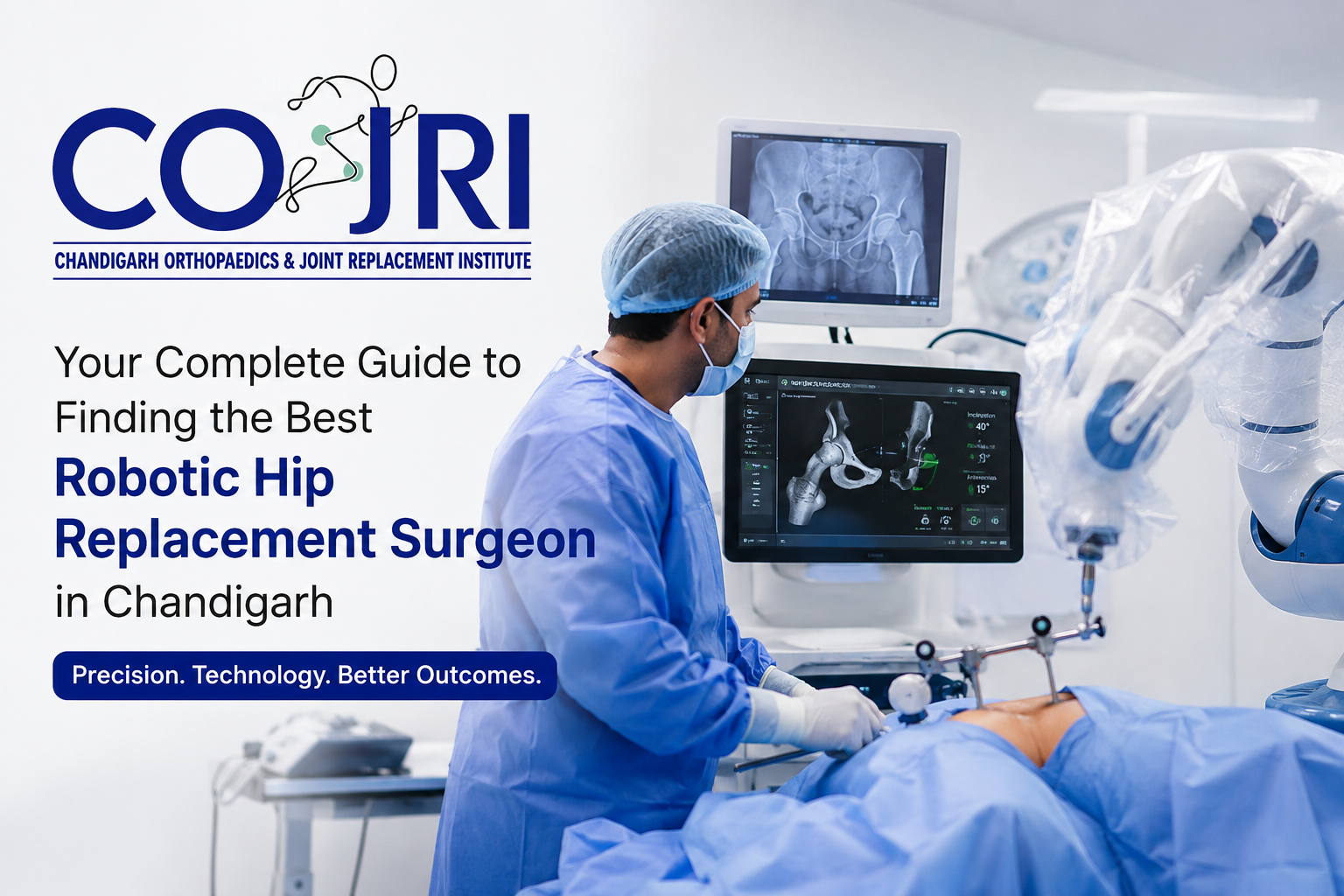
Choosing the best robotic hip replacement surgeon in Chandigarh is no easy feat. As hip replacement surgery continues to become more advanced, patient-centered robotic-assisted surgery is no exception. Knowing the additional services and access to technology your prospective surgeon provides is vital. Other services that differentiate your surgeon are: extensive experience in hip replacement, detailed assessment, appropriate implant selection, revision expertise, and a rehabilitation program.
If you are looking for the best robotic hip replacement surgeon in Chandigarh, this guide provides the important information to help you make that choice.
Importance of the Right Hip Replacement Surgeon
While advanced hip replacement surgery is no exception and aids in improving your mobility and significantly reducing pain caused by a hip damaged by a joint, arthritic, avascular necrosis, or other severely damaged hip joints, it is important to know;
Replacing a hip joint is more complicated than it seems. Your surgeon has to analyze your anatomy, your medical and activity history and long-term needs to adequately assess your bone quality and determine the best treatment.
At Chandigarh Orthopaedics & Joint Replacement Institute (COJRI), their highly specialized Joint Replacement Institute expertise has combined the latest innovations in Joint Replacement technology with advanced recovery support services to bring you the latest in hip surgery. COJRI offers primary Joint Replacement, robotic and revision hip replacement, as well as complex joint reconstruction.
What is Robotic Hip Replacement?
Robotic-assisted hip replacement surgery allows the surgeon to thoroughly plan the procedure using advanced technology, making the surgery less invasive and more precise.
A personalized surgical plan allows for evaluation of patient anatomy for optimal implant placement. The robot does not do the surgery alone; the surgeon is still responsible for all clinical and surgical actions.
The aim of robotic technology is to help surgeons with additional resources to allow for better planning and more precise surgical execution.
So, when reviewing hip replacement surgeons in Chandigarh, do not only look to see if a hospital has robotic facilities. Also, consider the surgeon’s experience in both hip replacement and robotic-assisted surgery.
7 Things to Look for in a Robotic Hip Replacement Surgeon in Chandigarh
1. Extensive Hip Replacement Experience
Pick a surgeon who focuses on hip and joint replacement procedures, and do not just go with a surgeon based on the availability of robotic-assisted technology.
Consider these questions:
- How frequently does the surgeon perform hip replacement surgery?
- Will the surgeon perform hip surgery on more difficult cases?
- What different hip replacement options are there from the surgeon?
- Will the team help with rehabilitation after hip surgery?
2. Expertise in Robotic-Assisted Surgery
This focus on experience is important when there are unique surgical challenges, like the patient has had surgery in the past, has loss of bone, has implants, or has had surgery previously.
A good consultation should answer the following:
- If robotic assistance is right for you
- How your hip will be assessed pre-operatively
- How the device will be chosen and where it will be placed
- What the available technology adds to the procedure
- What the expected outcome is
Robotic-assisted hip replacement is presented at COJRI as a focused precision technique for optimal placement of the implant with an aim for prosthetic longevity and functional longevity of the joint.
3. The Ability to Address Failed Hip Replacement Cases
Not all patients requesting hip surgery are first-time hip surgery patients.
Hip replacement surgery may be complicated by a loosening of the implant, wear and tear, infection, dislocation of the implant, fractures of the implant, or mechanical failure. Such cases may require revision surgery.
If you are looking for failed hip replacement Chandigarh, you should seek a centre with the specialty of revision joint replacement as opposed to clinics that perform primary hip joint replacement surgery.
COJRI performs revision hip replacement surgery for failed implants and provides management options for loosening, dislocation, wear, fractures, and infection of implants.
4. Thorough Assessment Pre-Operatively
A precise diagnosis is imperative to the formation of an effective treatment plan.
Your surgeon will evaluate:
- Current symptoms and your ability to walk
- Past medical and surgical history
- Imaging studies
- Quality of your bones
- Condition of your implants, if you have had a hip replacement
- Infection risks pertinent to your case
- General health and fitness to undergo surgery
Understanding the reasons for the failure of the original hip replacement surgery is critical for all revision cases before any other surgery is considered.
5. Access to Newer Implants and Advanced Reconstruction Techniques
Primary hip replacements and revision hip replacements are two different surgeries.
Revision hip replacement may be done in the presence of bone deficiency, as well as the presence of scar tissue and altered anatomy. In such cases, advanced implants and/or specialized reconstruction techniques may be required.
According to COJRI, their service for revision of joint replacement encompasses complex reconstructions, specialized implants, bone grafting, and advanced 3D printing technologies for major bone deficiencies.
6. A Well-Thought-Out Recovery and Rehabilitation Regimen
Successful hip replacement surgery is dependent on much more than just the surgery.
The recovery process includes a great deal of walking practice, strengthening exercises, physical therapy, and the gradual return to all normal activities. Your surgeon should tell you what to expect in terms of recovery and what activities must be avoided.
According to the primary hip replacement information from COJRI, patients progress from the initial supported walking to greater freedom of movement, with complete recovery usually taking several months.
Revision hip replacement may also include the complexities of reconstruction, loss of bone, formation of scar tissue, and thus may require a lengthy recovery with many restrictions.
7. Convenient Follow-Up and Multidisciplinary Care
Your relationship with the surgical team continues after the operation.
Think about the following factors when considering a surgeon:
- Accessible follow-up appointments
- Guidance for physiotherapy and rehabilitation
- Detailed postoperative information
- Assistance for postoperative complications
- Interaction and integration as required between surgeons, physiotherapists and other specialists.
Helpful and accessible follow-up appointments reduce the stress of the recovery process for patients and their families.
When Should You Consider a Hip Replacement?
Replacement of the hip joint may be necessary after the hip joint has become painful and/or stiff, leading to the restriction of the performance of usual daily activities, and has become unresponsive to other non-invasive treatments.
Signs may include the following:
- Constant pain in the hip or groin
- Pain during and/or after walking
- Pain during and/or after ascending or descending stairs
- Decreased range of motion of the hip
- Pain that prevents or disrupts sleep
- Increased need for and/or reliance on pain relieving medication
- Pain and/or physical limitations resulting in the inability to perform normal daily activities
Not every hip joint that is painful requires hip joint replacement surgery. It is important to consult an orthopaedic surgeon to evaluate the hip joint and to provide other treatment options, both invasive and non-invasive.
What If Your Previous Hip Replacement Has Failed?
Chronic pain and/or restricted mobility that is a result of a failed replacement is not always permanent.
A hip joint replacement may be revised if the original implant must be removed and/or revised due to the following reasons:
- Infection
- Repeated dislocations
- Loosening
- Wear
- Fracture of the implant
- Bone loss
- Mechanical failure
The reason for the revision dictates the course of treatment.
If you’re searching for Failed hip replacement Chandigarh, you should find a surgeon that frequently handles revision and complex reconstruction cases.
Questions to Ask During Your Consultation
While you’re compiling your list of potential questions, consider the following.
- What do you believe is the source of my hip pain?
- Is hip replacement surgery absolutely necessary?
- Would robotic-assisted surgery be an option for me?
- Which implant would you choose to use and what is the reasoning behind your choice?
- What is your experience with primary hip replacement surgeries?
- Are you able to provide surgical treatment for failed or infected hip replacements?
- For my unique circumstances, what are the potential risks?
- How lengthy do you estimate my recovery will be?
- What is the anticipated timeline for me to be able to walk, drive, and do all the things I did prior to surgery?
- What is the anticipated treatment plan for me post surgery?
You should leave a consultation with an understanding of your diagnosis, options with associated benefits and risks, and a complete overview of your treatment and recovery.
Why Consider COJRI for Hip Replacement in Chandigarh?
Chandigarh Orthopaedics & Joint Replacement Institute merges joint replacement professionals with the most innovative technology available for hip and knee health.
COJRI provides:
- Primary hip replacement
- Robotic hip replacement
- Revision hip replacement
- Revision joint replacement
- Complex reconstruction
- Fracture care around hip replacements
- Rehabilitation and recovery support
According to the institute, its surgical directors are Dr. Sandeep Gupta and Dr. Jatinder Singla. The institute has a surgical center in Max Hospital, Phase 6, Mohali and has clinics in Chandigarh and Panchkula.
When comparing surgeons, it’s critical to ask the right question. Rather than simply asking “Who is the best?” you should be asking “Which surgeon has the correct methodology and experience that align with my specific hip issue?”
Questions that are most frequently asked
1. How do I find the Best robotic hip replacement surgeon Chandigarh?
To find the best robotic hip replacement surgeon in Chandigarh, seek out a surgeon who has extensive experience with robotic hip replacement surgery, has a good understanding of the use of complex implants, advanced imaging, and the ability to deal with complicated cases that require revisions.
2. Is robotic hip replacement better than traditional hip replacement?
Robotic-assisted hip replacement is a more precise and advanced form of surgery, however, it should not be considered superior and therefore necessary for all cases. It should be your surgeons decision if robotic surgery is the correct methodology based on your specific diagnosis, anatomy and ultimate goals of treatment.
3. What causes a hip replacement to fail?
There can be many causes of hip replacement failure including dislocations, infections, loosening, mechanical issues, fractures around the replaced hip and wear and tear. In order to understand the cause of your specific failure, a complete evaluation is necessary.
4. Can a failed hip replacement be treated?
In many cases, revision hip replacement can address a failed or problematic implant. The procedure depends on the reason for failure, bone condition, implant status and surrounding soft tissues.
5. Is revision hip replacement more complicated?
Yes. Revision surgery can be more complex than primary hip replacement, particularly when there is bone loss, scar tissue, infection or damage around the existing implant. Recovery may also take longer in some patients.
6. How long does a hip replacement last?
Modern hip replacements can last many years, although longevity varies according to factors such as age, activity level, implant type and individual circumstances. COJRI notes that many hip replacements can last 15–20 years or more.
7. How long does recovery take after hip replacement?
Recovery varies from person to person. Patients generally progress gradually from supported walking to normal daily activities, while full recovery may take several months. Your surgeon and physiotherapy team can provide a personalized recovery timeline.
Final Thoughts
When looking for the Best robotic hip replacement surgeon Chandigarh, take care to find one with a wealth of experience, a meticulous diagnostic process, an appropriate strategy for implant selection, revision surgery, and a comprehensive strategy for rehabilitation.
When it comes to a Failed hip replacement Chandigarh, don’t think of chronic pain or lack of mobility as your new normal. A specialist can evaluate your situation to understand what may have happened and if you are a candidate for a revision.
For customized treatment, talk to a joint replacement specialist about your symptoms, former reports, and your treatment history for a better informed choice on surgery.
NAP: COJRI Contact Information
Name: Chandigarh Orthopaedics & Joint Replacement Institute (COJRI)
Primary Centre: Max Hospital, Phase 6, SAS Nagar, Mohali, Punjab
Chandigarh Clinic: Singla Clinics, House No. 3, Sector 19A, Chandigarh, 160019
Panchkula Clinic: House No. 222, Sector 4, Panchkula, Haryana 134112
Dr. Sandeep Gupta: +91 98159 33514
Dr. Jatinder Singla: +91 84272 70319
Email: info@cojri.com
Connect With COJRI
Connect with COJRI for more education on hip and knee replacements, robotic joint surgeries and other specialties in orthopaedic care.
- LinkedIn: Dr. Sandeep Gupta on LinkedIn
- Email: info@cojri.com
- Appointments: +91 98159 33514 / +91 84272 70319